
Across Central Florida, baby birds are beginning to leave their nests as part of an annual “baby season,” a busy stretch that runs from mid-March through late July. During that time, fuzzy fledglings can often be spotted in yards, sitting on sidewalks or in parking lots as they learn how to survive outside the nest.
At the Audubon Center for Birds of Prey in Maitland, the season brings a constant stream of tiny patients through the doors.
Since opening in 1979, the center has rehabilitated thousands of injured and orphaned raptors throughout the years, including vultures, eagles, hawks and owls. For birds too injured to survive in the wild, they also work to find them a permanent home, either at the facility itself or through other licensed wildlife care centers and educational programs.
However, spring and early summer are among the busiest months for staff and their fleet of volunteers, who spend weeks caring for young birds around the clock and preparing them to return to the wild.
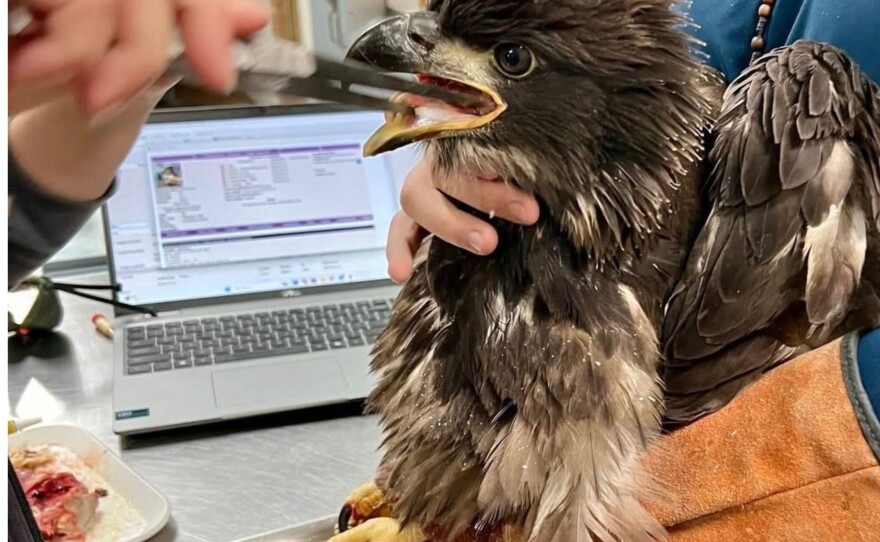
“Baby season is a lot of fun. It is also very busy,” Quinn Garrett, a raptor care assistant at the center, said. “We get a nice variety of patients, from eastern screech owls to barred owls to red-shouldered hawks to bald eagles.”
Garret said each species requires different diets, feeding schedules and medical treatment.
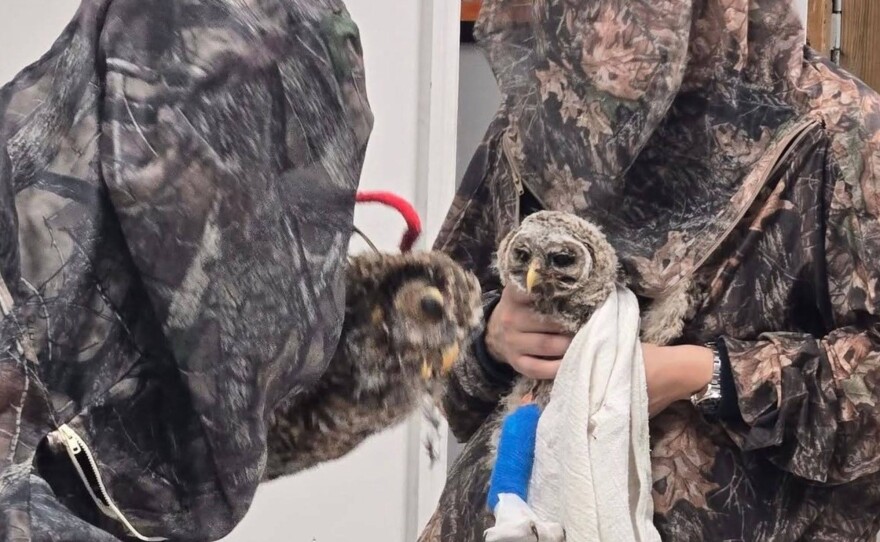
Inside the rehabilitation clinic, one of the center’s biggest priorities is preventing birds from imprinting on humans, a process where young animals begin associating people with food, comfort or safety. According to Audubon staff, that kind of attachment can make survival in the wild much more difficult.
To avoid that, care assistants often blend into the background… literally.
“We wear camo to avoid showing any kind of human interaction with them to avoid any type of imprinting,” Garrett said.
Feeding time is carefully designed to mimic what the birds would experience in nature. Sometimes that means staff members remain hidden behind camouflage while recordings of adult bird calls play through the room. Other times, it involves specially made puppets through permits designed to resemble adult birds.
“They're real birds. They're real specimens that we've turned into puppets, so they really are mimicking the adult of that bird,” Katie Warner, the center’s director, said.
Using preserved specimens mounted onto feeding tools, staff recreate the look and movements of adult birds delivering food to their young.
“We play adult calls and we feed them food because when in the wild they most associate with their parents when they're calling and coming back to the nest and bringing food,” Warner said. “So we try to mimic that time out in nature.”
This year, the center’s staff said they are seeing a surge of baby red-shouldered hawks, while eagle season is beginning to slow down. Staff members are also caring for several baby barred owls with help from two longtime resident foster parents named Phil and Hitch.
“Phil and Hitch are quite unique,” Warner said. “It’s actually two female barred owls and they're excellent parents.”
Once orphaned barred owls complete treatment in the clinic, they are moved into a nest box with the resident owls, who help raise them naturally.
“Phil and Hitch will get food dropped and they will bring the babies the food,” Garrett said. “They'll shred it up, they'll feed the babies, they'll protect them while they're in the nest box. They'll fly around and show them how to be a barred owl basically without any type of human interaction.”
Even with camouflage and puppets, Garrett said nothing fully replaces the role of real birds raising young birds.
But not every baby bird spotted on the ground actually needs rescuing.
Sometimes fledglings leave the nest before they can fully fly as part of a normal stage called branching, where they spend time on low branches or the ground while learning to navigate the world around them.
“If they do see a baby on the ground or out of the nest, definitely call your local wildlife center to get their input,” Garrett said. “Sometimes the baby could just be on the ground because they're branching, or there could be some underlying reason. But it's always good to check and make sure.”
By the time late July rolls around at the center food costs have tripled, and the hours have piled up.
But as director, Warner said for the people caring for these birds, baby season also brings something special.
“It’s just a feeling of accomplishment and knowing that you're giving back to the community and helping Florida’s land, water and wildlife,” Warner said. “Connecting birds and people so that people feel part of a bigger part in the ecosystem.”