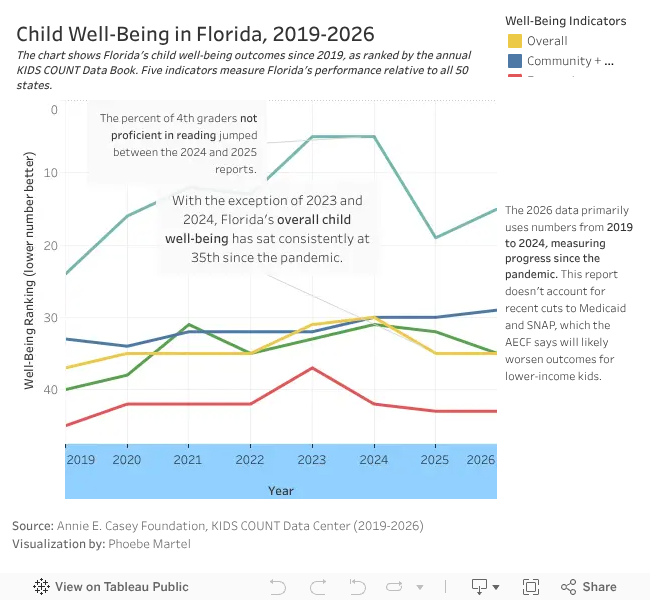
"Florida is once again ranked 35th in the nation for child well-being.
For nearly 40 years, the Annie E. Casey Foundation has released its Kids Count Data Book, giving a state-by-state look at children's welfare in the United States.
Florida has consistently ranked between 30th and 35th since the COVID-19 pandemic.
Florida Policy Institute, the state's partner in the Kids Count network, is urging lawmakers to prioritize lower-income kids.
"The level of investment is not moving the needle in helping Florida families with affordability in housing and access to healthcare, namely Medicaid," FPI analyst Norín Dollard said.
There are four main categories — health, family and community, education and economic well-being.
This year, the foundation implemented a new metric: a comprehensive score from 0 to 1,000. That number comes from 16 subcategories measured over a five-year period.
The 2026 report found Florida's children fall far behind their peers nationally in economic well-being. That ranking was 43rd, with a marked spike in children whose parents have high housing cost burdens.
The Center of Budget Policy Priorities found a quarter of Americans under 18 live in households that receive Supplemental Nutrition Assistance Program (SNAP) benefits.
Michael Cassidy, the foundation's policy director, said this year's rankings use data spanning 2019 to 2024. This means it doesn't account for federal cuts to public assistance programs through President Donald Trump's "Big Beautiful Bill."
"I think that's an important red flag for folks to understand," Cassidy said. "Outcomes are slipping, even before we account for those kinds of changes that are coming down the pike."
Cassidy added that policymakers must answer for how cuts to programs like SNAP and Medicaid will affect children's welfare.
The law expanded work requirements for adults to get SNAP benefits. Kids make up almost half of the population that no longer receives food assistance.
"Children do best when they have a strong foundation in which to thrive and live full lives," Cassidy said. "That means things like affordable healthcare, quality education and stable housing."
Florida performed best in the education category, ranking 15th , up from 19th a year earlier.
Still, a majority of its fourth-graders aren't proficient readers, with the number rising from 62 percent in 2019 to 67 percent in 2024. That compares with a rise of 66 percent to 70 percent nationally.
Cassidy said the impacts of remote learning remain a key factor, stressing the Kids Count data book is a relative measure.
Meanwhile, Dollard said state underinvestment in public education continues to play a large part.
"We don't pay our teachers enough," Dollard said. "There's widespread teacher shortages, so kids aren't getting quality education."
Certain young Floridians suffer worse economic health than others, Dollard added, pointing to growing school absenteeism among undocumented immigrant children facing deportation.
The foundation found that Black Floridians age 16 to 19 are more likely than their peers to be both not in school and not employed.
Still, the report has hopeful indicators that overall outcomes are improving for Black and Hispanic children. The extreme poverty rate has consistently fallen for those groups over the past decade.
Dollard pointed to Florida's family and community category, which showed the most improvement from 2019 to 2024. The ranking looks at the share of kids living in single-parent households and/or high-poverty neighborhoods.
Still, Dollard expressed uncertainty about whether Florida kids' welfare will improve in the coming years, with one particular decision playing a pivotal role.
Florida voters are scheduled to vote in November on a Gov. Ron DeSantis-backed plan to reduce property taxes on homesteaded residences.
Dollard said that, if it's approved, public schools and voter-approved children's trusts could lose needed resources.
"The proposed constitutional amendment to eliminate property tax will take out a significant amount of revenue," Dollard said. "These children's service councils decided we want to tax ourselves to help our kids."
Copyright 2026 WUSF 89.7