It’s election season in the U.S., and at the time of writing, there’s just over one month until the November general election.
There are lots of important races on the ballot, but one here for some Central Floridians is especially important.
In April, Florida Republicans redrew the state’s ninth congressional district to give their party an edge for a seat that’s been held by a Democrat since 2013. Before the district was redrawn, it encompassed all of Osceola County, including a thriving Hispanic and especially Puerto Rican community, plus parts of Orange and Polk counties.
To tilt the political playing field, lawmakers roughly tripled the district in size while keeping the same total number of voters. Now, it runs about 120 miles long and 70 miles wide, covering an area the size of Connecticut.

South Osceola
Leaving just after 7 a.m. on Sunday, it’s a brutally humid day out in Orlando.
Driving south past the sprawl of Kissimmee and St. Cloud, the strip malls and warehouses give way to trees, farms and winding roads. The morning sun gilds the dew in the fields while cattle and horses graze.
Until getting to Indian River County, the biggest establishment of note is the tiny town of Kenansville, a loose collection of buildings along the road meant to serve the area’s farmers and ranchers.


Early on a Sunday morning, though, it’s quieter than usual.
Vero Beach
I’m driving south through Osceola County, headed toward the first proper stop on my road trip in Indian River County, one of the district’s new counties.

It brings Florida’s coastline into a district that has until now been landlocked. Here, water is a big deal. Locals and tourists alike come to Indian River County for its beaches and treasure hunting, and it’s also home to wildlife that draws tourists and fishermen.
After stopping by Vero Beach’s proper downtown, I continue on east to reach the beaches on the outside of the bay.
Chris Madsen is soaking up the sun on the beach on Humiston Park with her friend Mia Sullivan.
“It can't get any better than this,” Madsen says.

Both Madsen and Sullivan moved to Vero Beach about five years ago. Sullivan left Colorado for Florida to care for her mom in retirement.
Sullivan works with volunteer conservation groups like the Ocean Research and Conservation Association and the local Environmental Learning Center. She wants to see a representative who will fight for water and environmental conservation, in Vero Beach and elsewhere in the district.

“Most people come here and rent Florida, or they use Florida like they're renting it, as I like to say,” Sullivan says. “People don't treat it with the respect and the conservancy it needs.”
Numerous species of fish, birds and marine wildlife make their homes in Indian River County, too, including sea turtles, manatees and it’s one of a few places in the world where you can see bioluminescence.
The federal government has a rich legacy of environmental conservation in Indian River County. Theodore Roosevelt established America’s first national wildlife refuge on Pelican Island, about 11 miles north of Vero Beach.


Congress plays a big role in conservation, allocating billions of dollars each year to agencies and organizations for research and public improvement programs.
People in this are hopeful that whoever is elected to represent them in November is focused on keeping the environment front and center even with the concerns of cities like Kissimmee and Orlando in the mix.
“People in Orlando, they probably don't really think too much about sea turtles, not in general,” Sullivan says.
Sebastian
Just north of Vero Beach is Sebastian Inlet State Park, packed to the gills this Labor Day weekend with visitors from across Florida — and the country — to fish off the pier.
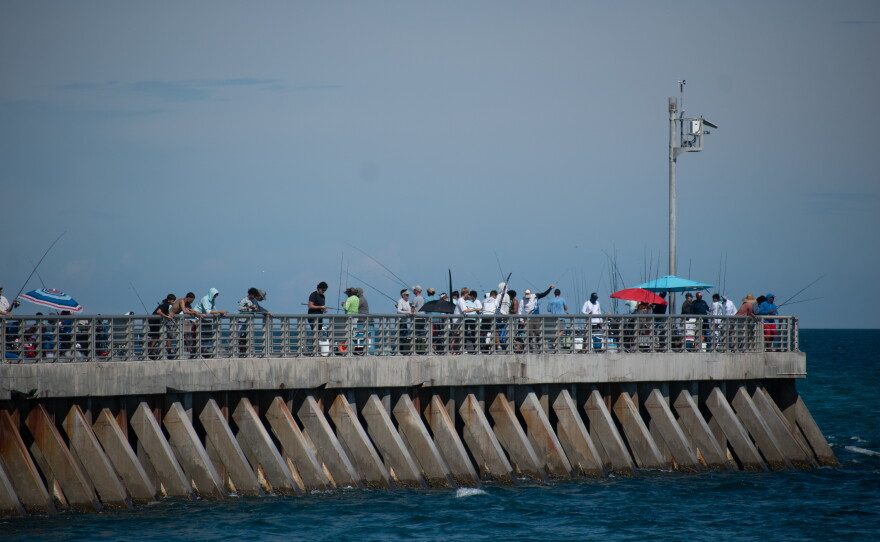
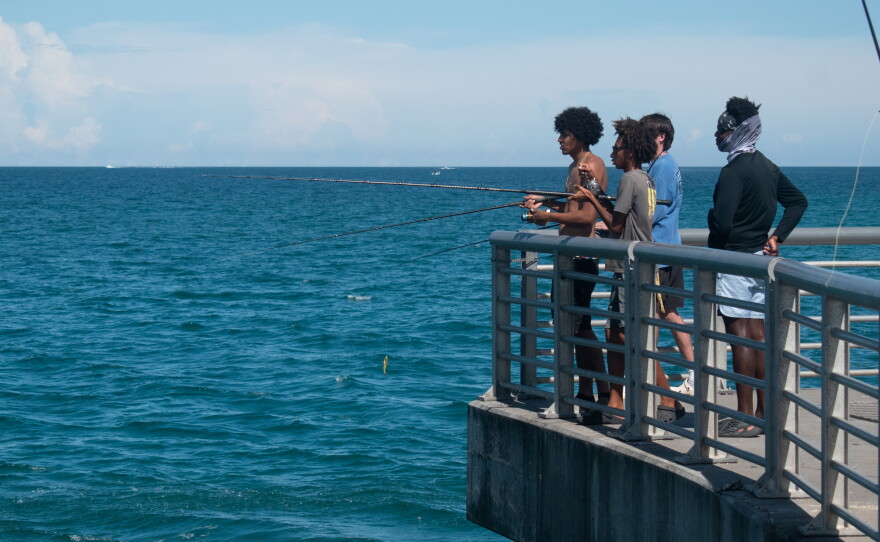
Most of them have been out since dawn with chairs, coolers, canopies and buckets, hoping to catch a snook. Some are visiting from Brevard; one is from Michigan. By the time I stop by in the late afternoon, reality seems to be setting in that the big fish are probably done biting for the day.
After dusk, the bars come to life with visitors from the south — many coming up for the weekend on their boats from Stuart, another coastal community close to Port St. Lucie.
Locals — and bikers — instead hang out at Earl’s Hideaway for pizza or drinks.

“I think Earl's is probably like the epitome of what Sebastian is,” says Kimmy Johnson, a patron. “It's like — older, biker-ey, alcoholics.”
“If you don't have a boat, you probably have a bike, and you're definitely at a bar,” she added.
Johnson grew up on the Treasure Coast, the strip of communities from Stuart up to Melbourne named for the wreck of Spain’s “Treasure Fleet” here in 1715. She lives in Vero Beach. Compared to Sebastian, it’s “a little younger [and] a little richer,” with a huge age gap.
“Honestly, I don't even think there's really like 35- to 45-year-olds,” she says. “You're either 20, 21 or 60.”
That’s difficult for young people like Johnson, who is 28.

“Being in Vero in your late 20s is pretty hard,” she says. “All my friends or people I grew up with who are my age are not here anymore. People are like, ‘Oh it's paradise,’ but if you grew up here, you get sick of seeing the same 10 places over and over since you were 21.”
Work keeps her in the area. She installs systems in planes for Piper Aircraft, which is headquartered here because of its especially sunny and mild climate, even by Florida standards.
Johnson cares about preserving the county’s beaches and avoiding the excessive growth that she says has taken over Port St. Lucie, where she’s originally from. And she believes “gender and … sexual orientation … [don’t] need to belong in politics. That’s love. … It doesn’t matter.”
But she acknowledges that she’s disconnected from politics — and social media — except for what she hears through her boyfriend, who “is way more into politics.”
“I specifically stay away from politics because that's how I keep my life peaceful,” Johnson says. “Because, honestly, … it's very bleak, to say, [but] I don't feel like I have that much of a say.”
It’s hard for her to be engaged unless an issue is affecting her “on a personal level” and is actually visible in the community.
“And that's probably bad,” Johnson adds. “Because then it could be too late.”
Okeechobee festivities
The next day, I hit the road again, headed off to Okeechobee, about 40 miles southwest of Indian River County, for its annual Labor Day parade and festival.
Okeechobee, both the city and the county, share a name with the lake they border, the largest in Florida. And for generations, it was dominated by cattle ranchers and fishing.
You can see that legacy in Flagler Park, the five-block strip of green that defines the city's downtown. A few years ago, the town raised money for Cattlemen’s Square, commemorating the town’s history with 10 bronze sculptures of cows and cattlemen.
But on Labor Day, those statues are flanked by hundreds of residents for its annual parade and festival.
As the school marching band, antique cars, pageant winners and horses parade down the thoroughfare, camaraderie mingles with humidity in the hot morning air. The two party nominees for Congress in District 9, incumbent Democrat Darren Soto and Republican Dan Green, both make appearances.


Once the parade winds down, the crowd indulges in an assortment of food trucks and live music.
Ron Altice is a retired public schoolteacher here. He says he’s tired of extremism in politics.
“We just need to get this government back toward the middle somewhere,” Altice says. “It's just gotten crazy. You know, I'm registered Republican, but I've just about quit voting Republican because of all this stuff that our President Trump is doing.”

A couple of hours before the festival is set to wrap up, a hard rain forces everyone out, and the day quiets down.
A quieter evening
Driving around, it’s difficult not to notice all the supply yards and industrial sites. It’s obvious that the economy here is changing, beyond just ranching and fishing.

For a town of about 5,000, there’s a lot of chain businesses, and the figure keeps growing. There’s Home Depot, Dairy Queen, Starbucks, Walmart, Golden Corral, Dunkin’, Pizza Hut, Domino’s, Bath & Body Works and countless others. Several residents worry that the growing number of chains is erasing the community’s character.
And voters at the festival pointed out that the town is a popular destination for snowbirds, too.
In the evening, a few vendors are set back up for a concert in the park. As the sun sets, people are playing games and camped out on chairs to listen, though nowhere near as many as in the morning.
That’s where I meet Jesus Romano, the store manager at Okeechobee’s AT&T store. Moving here in January after a few months commuting to the job from Port St. Lucie, he’s noticed the growth of chains, too.
“I see things opening up all the time,” Romano says. “Like, I heard that they're almost done with … a Chipotle here, and then a Wingstop is coming next. … There's [an] Applebee's literally down the road from here. “
His mom has been living here for four or five years, tending to a few cattle, chickens and horses on her small farm north of town.

“She grew up on a farm in Puerto Rico,” he says.
Romano wants to see funding for more lighting on the highways near town, which he says can be dangerous at night.
A legacy of dairy
The next day, I stop by a drive-through convenience store before paying a visit to the Sutton Dairy Farm a few miles north of town.
While I wait to meet with one of the owners, a herd of goats regards me with curiosity from behind their fence.
The Rucks family has been operating this farm for several generations. Today, Sutton Rucks runs it, overseeing about two square miles and 16,000 gallons of milk production a day.
“Farmers are the only part of our society that sells everything wholesale and buys everything retail, and we pay the freight both ways,” Rucks says, paraphrasing a line from John F. Kennedy.

While giving me a tour on a side-by-side, he says that not everyone understands how unpredictable agriculture can be.
“If the US dairy industry has an increase in production in South Dakota and demand has dropped a little bit for cheese or whatnot, cheese or whatnot through consumption drops or increased production, it all impacts our milk price,” Rucks explains.

Because things are so unstable, he worries about inflation, and Florida’s recent increase of the state minimum wage.
“I struggle with that minimum wage being raised the way it's been raised. … Because we don't have that opportunity to pass any of that cost on to anyone else,” Rucks says.

Soto, the incumbent Democrat for Florida’s Ninth Congressional District, has been representing citrus and cattle farmers in South Osceola County since he was elected in 2016.
In April, he was one of 14 Democrats who broke with the party to vote for the GOP-drafted federal Farm Bill. And he’s been endorsed by the National Cattlemen’s Beef Association and Florida Citrus Mutual.
Green, the Republican nominee, has yet to make detailed campaign statements about agriculture online. But earlier this month, Florida Agricultural Commissioner Wilton Simpson, who is also a Republican, endorsed him.
At the end of the tour, I shake hands with Rucks, contemplate for a moment the miracle of modern agriculture, then clamber back into my car to drive west to Glades County.
About this project
Dispatches from the Ninth Congressional District is a four-part series exploring what potential voters throughout the newly redrawn and expanded area are looking for in the next person they elect to represent them in Congress. The district was redrawn to include more white Republican voters after President Trump urged red states to redistrict to try and hang onto power as midterm elections approached.