Can stepping outside your own world teach empathy in a time when division feels inevitable?
Central Florida Public Media and StoryCorps are bringing together strangers with differing political views for guided One Small Step conversations.
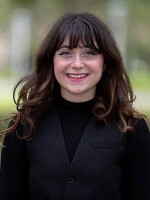
Shia Kirby, 20, is liberal.
Allie Nichols, 21, is conservative.
The University of Central Florida students, who have only seen each other through Zoom calls with their classmates, had never met in person and never talked politics, but they sat down together to find common ground.
“I think growing up in the suburbs in sort of a nice white neighborhood, for lack of better words, made it easy for me to stay where I was, being comfortable with not really seeing bad that goes on in the world,” Nichols said. “So the suburbs, it's good to get out of them sometimes.”
Kirby said she shared a similar upbringing in a majority white neighborhood.
“I often ended up being the only Black girl, if not the only like Black student in my classes so it was a bit isolating,” Kirby said. “The only people that looked like me were my family members, and then I'd go to friend's parties, and I'm the only person worried about (how) I can't get my hair wet.”
They both agreed that going to college helped them step outside the echo chambers they grew up in and reevaluate their beliefs. Kirby said it allowed her to think and make decisions beyond the conservative and Christian values she was raised with.
“Meeting other people was also part of that experience, helping shape my opinions of where do I kind of fit into the state of the world right now? What's my role?” Kirby said.
“You meet so many new people and people from so many different backgrounds, because it's no longer the same school county,” Nichols said. “There's just so many stories you can hear from other people and learn perspectives.”
Meet Shia Kirby

Shia Kirby is a junior political science and rhetoric writing major at the University of Central Florida.
“I am super involved in politics, if I'm not studying it in a class, I'm researching it in my free time, I think my Tiktok and Instagram have been trained to show me politics,” Kirby said. “It's draining because there's just so much happening, there's so much chaos, so it's kind of burdensome, but also it's one of my passions.”
Kirby and her family immigrated from Trinidad to the United States in hopes of receiving better healthcare, Kirby was born with a birth defect impacting her eye.
“One of my eyes wasn't fully formed at the time of birth, and eight surgeries were actually the doctors trying to correct it up until the point where they were like, let's just scoop it out,” Kirby said. “Being permanently disabled is me only having one eye, I actually have a prosthesis in my right eye.”
Kirby said she grew up in a conservative county and not only was she the only Black girl, in middle school, she said she realized she was also queer.
“I grew up under the belief that homosexuality was wrong and that it was something that you shouldn't partake in, and that it was okay to have the feelings but not the actions,” Kirby said. “So I kind of repressed all of that until the end of middle school, early high school, where I was like I can't really ignore that anymore.”
She said after years of navigating questions around identity and faith, she’s now focused on building more community.
“I really am focused on community like sharing resources, building or establishing community organizations, and community events that strengthen different communities,” Kirby said. “But also thinking about equality and making sure that marginalized communities and voices are represented even at higher institutions of government.”
Meet Allie Nichols

Allie Nichols is a junior psychology major at the University of Central Florida.
“I want to preserve traditional Christian values, the family, the importance of family, and the importance of life and the role of government in all of that,” Nichols said.
She was adopted from China at 11 months old and grew up in Central Florida surrounded by a large, close-knit family that she said shaped her values.
“My mom really instilled in me, family is everything, family comes first,” Nichols said. “You will do everything for your family because family will do everything for you.”
Nichols said she grew up Christian and her sense of family strengthened her return to faith after losing someone important in her life.
“My grandma passed in 2020; she had pancreatic cancer, and she's also somebody that really impacted me,” Nichols said. “I feel like she didn't really get to see me be an adult, but when she died, I really came back to faith, and I really thought about everything she left for us, these messages of family and love, and everybody is a person that deserves love at the end of the day.”
Nichols said she tries not to think too much about politics but has become more aware of how her faith is portrayed in popular culture.
“I am realizing how important the misrepresentation, and sort of, for lack of better words, bullying of the Christian faith in the media,” she said. “Like that Sidney Sweeney movie the Nun,sometimes they can misrepresent Catholic faith especially, and while I myself am not specifically Catholic, it's just kind of hard, because you don't really see that with other religions.”
The Takeaway
Kirby and Nichols discussed what they see as the biggest challenges dividing people today.
“There is a significant lack of empathy in today's current time, and I think that's been heavily pushed by social media and the ability to be anonymous behind a screen and be so hateful,” Kirby said. “I also think this very strong polarization of my side, your side mindset, is super harmful to us as a society.”
Nichols said part of the problem comes from self-centered thinking.
“That makes a lot of sense, it's hard to come together when everybody's me, me, me,” Nichols said. “I think it's the labels, it's Republican versus Democrat, conservative versus liberal, we could never get together or be friends and that's just really sad to me.”
“I think that stops so much conversation and growth and areas to actually build community with one another,” Kirby said. “We're not going to be able to achieve any goals if we're unable to actually sit down, calm down, and hear other people out.”
“That's what matters at the end of the day, coming together,” Nichols said.