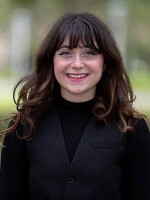
When a woman who opened doors meets a girl now free to walk through them, what do they learn from each other?
Central Florida Public Media and StoryCorps are bringing together strangers with differing views for guided One Small Step conversations.
Janice Brodie was about the same age as the middle school girl sitting across from her, when she walked into a newly desegregated school for the first time.
“I didn’t think it was going to be such a bad transition,” Brodie said. “Boy, did I have a very different experience.”
Now at 74, she said she considers herself “the first in everything” during the period when African American students were just beginning to enter predominantly white classrooms.
Thirteen-year-old Noa Jerelds said she knows a different world, and that today’s schools feel diverse and full of possibility.
“We’re going to be the next teachers, the next inventors, the next astronauts,” Jerelds said. “Our world is unlimited to me.”
Sixty-one years separate them, but the two recently sat down together.
Jerelds asked Brodie what she worried about most at her age.
“Kind of staying alive, I was raised in segregated public schools, and was one of the first African American students who went to a predominantly white school,” Brodie said. “I was such a miss Pollyanna, coming from the Black environment that I came from, I'd never had people treating each other mean.”
Brodie said that once she entered a newly integrated school, the hostility was immediate.
“I had teachers tearing me down. One told me, ‘You can’t pass my class,’” Brodie said. “I did well in the class, and I thought at the end she would come back and say something encouraging. She took an application I had that I had given to her to sign, and she tore it up and threw it in the trash can.”
Still, Brodie said she found strength and support through her culture and community.
“I loved having my African American culture to always fall back on, but we had to learn how to push through in this new environment,” Brodie said. “And it was not easy, it was really not easy.”
Jerelds said school for her now is very different, with diverse students and staff.
“One of the high schools I'm planning to go to, they have a Black principal, which I'm really looking forward to, because I think that's super cool,” she said.
However, she said she also understands that discrimination hasn’t fully disappeared, not from her own experiences, but from her mother’s. Her mom often used relaxers to straighten her hair, trying to meet what she called the “American beauty standard,” defined by straight hair typically associated with white women.
“I remember going to the store when I was younger when relaxers were still popular, I would see them on the little shelves and be like, ‘what's that?’ and my mom be like, this makes it so your curls don't show anymore,” she said. “My mom lost a lot of hair because of it all, because she wanted to fit in so she wouldn't be picked on anymore and I was like, I wish you embraced your natural curls more earlier.”
Meet Janice Brodie

Janice Brodie spent more than 40 years in leadership roles across education, student mentorship, and philanthropy management. Over her lifetime, she said, she belonged to a generation of firsts, moving through desegregated schools and breaking barriers for those who would follow.
“My growing up was marked by assassinations, by John F. Kennedy, Martin Luther King, Malcolm X, those were turning points,” she said. “Now it almost seems like we're repeating some of that, which is sad to me, but I guess the other thing is, is that despite that, we're still going forward.”
Brodie said she became deeply involved in the politics of her era, encouraged by her family and driven by the needs she saw in her community.
“Because it was the 60s, 70s, especially, I got to be part of the kids that stormed the president's office,” Brodie said. “I got to help with the feeding programs of the Black Panthers, and got to do a lot of community focused things because the need was so present. But what it also made me do is to try to understand, why do people see things the way they see them?”
Looking to the future, Brodie said she worries about history being erased.
“It took my lifetime for our history to even be acknowledged and to be seen and to be heard, and now there are forces that want to just wipe that out again, and it feels like that's going backwards to me,” Brodie said. “On a more positive note, I think people are not looking to governments or political leaders and placing all their trust in them, I think we're beginning to look at each other and say, how do we help each other? How do we care for our neighbors and our communities?”
Brodie said despite everything, she’s proud to be a part of her generation.
“We're still here, we've lived through a lot, and we've lived through phenomenal change, technology, environment, the cultures that we are now all a part of,” she said. “It used to be you were in your little cocoon of a culture, and that's pretty much where you stayed, now you're part of the world, even if we're in Orlando, we've lived through it and have found value in it.”
Meet Noa Jerelds

At only 13, Jerelds has built up a resume like being inducted into the National Junior Honors Society, becoming a standing member of the Orange County Regional history team Council, and has hopes of becoming a marine biologist.
“When America was first founded, the main goal was always money, and that's still around today, but I think the more important thing is education,” she said. “If you don't have a good education, you can't earn good money, I’d rather work hard than just get it easily, because I want to feel like I earned the money. I want to feel like I earned the place that I am in right now.”
Jerelds said that as she works toward her goals, those who inspire her most are people who look like her.
“With all the hate that our race gets, it's really inspiring to see someone like me get that far in life, and it gives me inspiration, I can do that too,” she said. “I don't have anything holding me back, not these comments, not these words, it's just me,myself and I in this world, and I have to get myself there.”
She said she’s also very in tune with politics and is closely watching the current administration.
“I'm nervous about if the government is focusing on the wrong things,” Jerelds said. “They're more focused on banning phones than like the shooters coming into the school and terrorizing children. It really makes me sad because I don't want my future kids or generations to have to deal with that. I don't want these little kids to be crammed into a corner worrying about, am I going to make it out alive?”
Though she’s only in middle school, Jerelds said she already misses her younger years, a time when she didn’t have to think about the state of the world or her safety.
“Parents don't shield their children anymore, because we're exposed to everything. We have our own cellular devices that we can simply look up what's going on in the world,” Jerelds said. “I missed the time in elementary school where politics didn't matter, basically, and it was just fun and games and recess and we weren't quite exposed to the world yet.”
The Takeaway
The conversation moved through talk of icons, goals, politics, and race, eventually circling back to their shared history.
In March 2025, President Trump signed an executive order directing a review of Smithsonian exhibits and other federal sites. The order’s review was for “improper ideology,” anything that is “divisive or anti-American,” at sites.
Jerelds said she’s worried museums about Black history will be shut down or affiliated artifacts will be removed.
“I'm so lucky, and I'm so happy that I got to visit before they started shutting it down, because it was a really pretty experience for me,” Jerelds said. “I went with my dad and his friend, we're all African American, so it was really insightful for me, they showed us the hot combs and the music. Looking back at it now, I feel sad for the people who didn't get to experience it, because it's really beautiful.”
“I agree with you wholeheartedly, and we are working to make sure that it does not close,” Brodie said. “If there's a legacy that we want to leave is that we want to make sure there's always a repository of Black history, because Black history is all of our histories, and for anyone to suggest that you could tell the story of America and leave anything out of the African American experience is just asinine.”
“My favorite part in history is probably hearing about all the African American people who did do something,” Jerelds said.
“There's so many stories of resilience and so many stories of overcoming and so many stories of excellence in the face of mountains and mountains of obstacles, and yet we're still here, and we are here in the future,” Brodie said. “I don't care if somebody says they're not teaching. I'm not worried about somebody else teaching our history. I want us to teach our history, because nobody has the right to deny your experience. Your experience is your experience.”
From the age of 13 to 74 and decades of experience combined, the two said Black history is American history and want to preserve it for future generations to come.